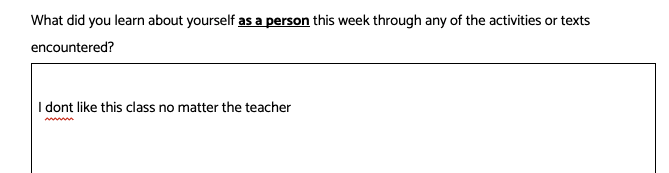
(Or in my case, the 8th graders who are usually in front of Matt Hosler)
I haven’t been in classrooms as much this year. Blame it on accreditation; blame it on misplaced priorities. I have missed it. Beyond missed it. So when Matt Hosler asked if I might be interested in taking over his 8th grade English class for a week while he was on paternity leave I got fairly breathless with excitement:
“Wait- can I take it over-take it over? Like actually plan, teach, grade?”
“Sure. Do whatever you want.”
(Swoon)
Coincidentally, this first blog blast of 2023 is dedicated to “Teaching the Students in Front of Us,” as is our final PD Day installment of “High Expectations/Strong Supports.” Also, as Hollie and Buck pointed out, the date of this blog blast release happens to coincide with Valentine’s Day 2023. So maybe we should call this “Love the students you have; not the students you wish you had.” Or, if we take the Episcopal Identity route, how can we ensure our pedagogical choices “respect the dignity of all human beings”? These invitations beg some questions:
- Is it possible that our “high expectations” tend to privilege some ways of being in the world more than others?
- How can we actually enforce high expectations if we don’t recognize that students have varying degrees of ability to reach those?
- How can we provide strong supports if we don’t match those supports to the individual human needs that populate our learning spaces?
The idea is if we can better account for all of the differences our youth bring (identity markers, skill level, experiences, speed of processing, religious beliefs, personal interests/passions, etc.) we can curate our own classrooms to meet them where they are through varying content (the knowledge/skills a student should master), process (activities students use to master that content), and product (the methods students use to demonstrate learning.) If anyone is new to differentiation, here’s a lovely module that helps explain it. This work, to me, works best in concert with work on culturally sustaining pedagogy. It is impossible and also unnecessary to differentiate everything, all the time, because we have some scientific grasp on what activities and learning experiences work best for which learning goals. (See this blog if you are feeling like it’s all too much.) But enough professor talk. Back to me.
I spent an ungodly number of hours over Christmas break dreaming of all of the perfect one week units 8th grade ELA units that could ensure. I’m no newbie, so I knew all elements of perfection would evaporate the minute my first student entered the room. Still . . . the possibilities! I read about 62,000 personal narratives to find the perfect mentor texts. Poems too. I sat in a coffee shop like the good old days when I was a teacher creating my weekly assignment sheet. Heaven.
Then I taught the students in front of me. Ya’ll the current eighth grade class is indisputably delightful. Everyone says it. Still, the minute my plans left the google slideshow and leapt into the reality, I learned a thing or 5000. Or, more accurately, I re-learned them. Teaching middle school is a bit like riding a bike, but to be fair if it’s been a solid 15 years since you’ve ridden a bike, you are bound to have a wobbly start.
- No matter how much I harped that it was important and even discussed it explicitly in class, students didn’t internalize the rubric until they “graded” a shared text using those categories and discussed them together.
- 8th graders, no matter how unerringly delightful, cannot be trusted. Or to be more precise, don’t give them a five minute break without clear direction or likely one student will choose to climb a tree and Susan Pace will walk out with her class and likely be like, “Wow- Julie Rust has no control over those kids.”
- Many of them are silently sitting there being brilliant. Don’t confuse silence with lack of interest or absorption.
- OHMYGOSH writing with them and projecting what I am writing is so so helpful. The whole vibe of the room changes when I am engaged in the practice alongside them.
- The sheer mass of interactions when you see them all on Monday numbs you to the few negative ones.
- On the other hand, one negative dynamic can shift an entire class.
- Grading well= SO. HARD.
- The best way to get students what they need for writing is popping over to the desk when they are EARLY and IN THE PROCESS of writing that first draft and dialoguing about how it is going. Waiting until they write a full first draft and then just providing written feedback is far, far less efficient.
- There is no better way to teach than to start a mini-lesson off with exemplars of student writing that are gleaned from the writers sitting in front of you. “What?! You actually read my writing while I am still in the process of my first draft? And you think the rest of the class could learn from something I’ve done?!”
- Julie Rust- you still make way too many copies that you never use. Just like your first year of teaching.
- Two jobs at a time is dumb. I should’ve canceled my other one that week I taught and not tried to do both.
- 40 year old Julie is such a better “I am an authority in this room” person than 22 year old Julie was. I also take everything less personally and love them so much more. . . possibly because now I see my kids in them.
- Beautiful days= the enemy. When they say “Can I work outside?” the answer is no unless I am fully camped out there.
- I vacciliate very quickly between loving who I am with them and hating who I am with them.
- “Focus music” is magic for the feel and focus of a class during work time.
- There is still NO BETTER CLASSROOM VIBE for me in the world than when 20-some 8th graders are in the zone and writing furiously.
- Every single time I have students fill out a weekly reflection I am shocked by what they share about their learning and the class. The magic is always in the meta.
I think that teaching the students in front of you is, of course, what every single faculty member does every single day whether or not you subscribe to a theory of the importance of differentiation. I mean, it is implied in the job description. But I hope that this month’s theme and the collection of blogs we produced help orient us to the fact that Step 1 in this important work is paying attention to the students around you. Step 2 is being responsive to all the stuff they bring: the crazy behavior, the passions/interests, the strengths/weaknesses, all of it!

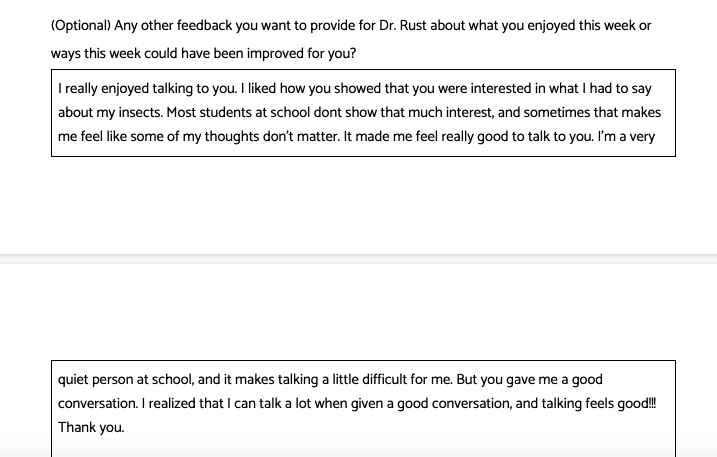
Of course, sometimes this takes more grace for some students than others: 🙂